


At Cheese in Bra, our employee Theresa also visited the stand of the renowned English cheese affineurs Neal's Yard Dairy. The cheeses are truly incredibly good, so today Theresa would like to introduce you to one of her favorite cheeses: Stichelton!
Stichelton is the historical name of the town of Stilton, which gave the famous cheese its name. Since 1996, according to the protected designation of origin, Stilton must be made from pasteurized milk – reason enough for the dedicated British cheese merchant Neal’s Yard Dairy to develop a new raw milk cheese, virtually as a reissue of the historical Stilton.
In the experienced and adventurous Joe Schneider (a native-born American and, among other things, a long-time Gouda cheesemaker in Holland), Neal’s Yard Dairy found the ideal partner in implementing this ambitious project, which started in 2004 and produced the first cheeses in 2006 after two years of development.
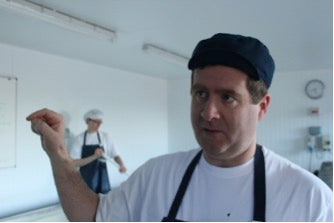
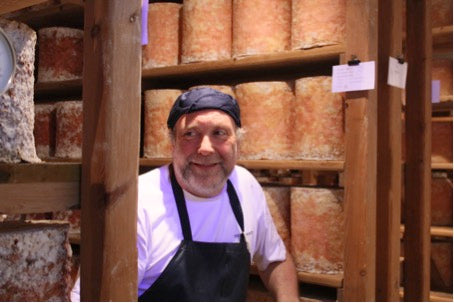
A few years ago, I had the opportunity to visit Joe Schneider at the organic Collingthwaite Farm in Nottinghamshire and spend a day on the farm and in the cheese factory.
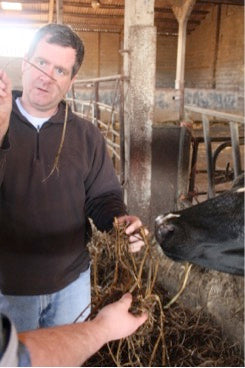
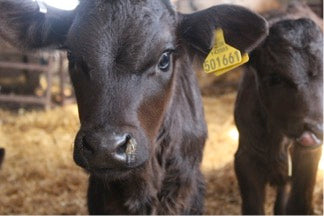
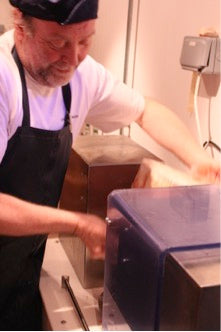
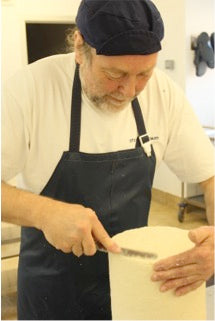
It was an impressive and educational experience, after all, I had to pitch in when it came to quickly scooping the curds, thoroughly sealing the fresh cheese wheels, and carefully washing the rind.
Since the cheese factory exclusively produces Stichelton, this always means the same daily work steps/manual tasks, constant repetition, and thus the refinement and specialization of the individual processes. You can taste this in the cheese, which has continuously developed and improved since the year of its creation.
For example, Joe now uses a minimal amount of animal rennet to curdle the milk: 30g of liquid rennet is added to 2500l of milk processed daily - significantly less than is customary in other cheese recipes. This results in a particularly soft, loose curd that resembles fresh silken tofu in its consistency and must be processed accordingly carefully.
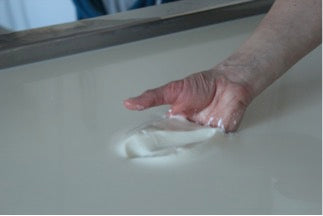
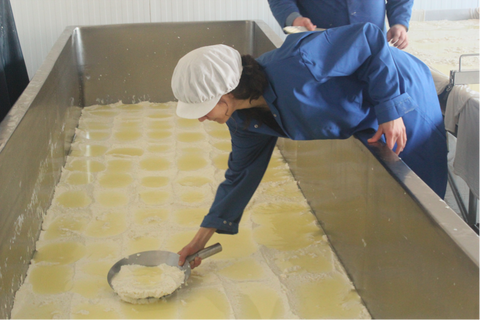
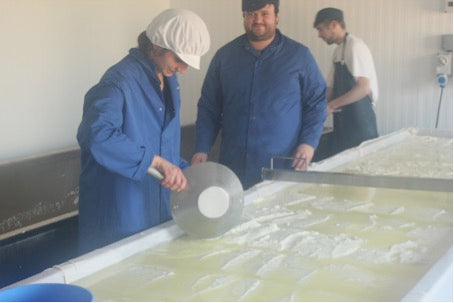
Thus, the resulting cheese curds are scooped by hand in soup-plate-sized portions after being broken down with the cheese harp, so that the whey can drain gently. In the matured cheese, this elaborate process results in a particularly creamy texture.
Another special feature is the minimal use of starter cultures combined with careful control of the pH value and temperature throughout the entire production process.
These bacterial cultures, among other factors, shape the complex and long-lasting flavor you experience on the tongue with a piece of Stichelton: creamy-fresh, nutty-caramel, tart-spicy.
Unlike other blue cheeses, the fresh Stichelton wheels are carefully sealed and only mechanically pierced after six weeks of maturation; in this way, a complex aroma can develop in the cheese that goes beyond the classic blue cheese notes.
And if you have become curious to taste it yourself or learn more about this exciting cheese, then visit us at Emser Straße 42 or use our convenient cheese shipping offer.

