


Maître Philippe & Filles are known for French cheeses, and that is probably for the best. However, it is rumored that the Dutch also produce quite respectable cheeses …
The most famous Dutch cheese is Gouda, a large round hard cow's milk cheese, ideally without holes, which comes from the eponymous Dutch village or is at least named after it. The name itself is not protected, which is why Gouda can and is made all over the world. It is therefore no surprise that the quality is not always up to par.
Gouda is available young, medium-aged, and aged, made from pasteurized milk, sliced … You can find it in any supermarket or discount store … but there are still producers who make it traditionally from raw milk. You can buy it whole and of excellent quality from specialist retailers.

We too count among our few selected non-French cheeses a genuine Dutch Gouda, currently one that has been aged for thirty months!
But where does Gouda actually come from? And are there still farmers in the eponymous village who make it traditionally?
To find out, I went to Holland with a film crew from Kabel Eins. For the show “Abenteuer Leben – täglich neu erleben”, we wanted to uncover “the secret of genuine Gouda” and set out in search of so-called Boerenkaas (farmers' cheese). We had our luck with the De Jong family, who have kept cows on their Jongenhoeve farm for generations and make genuine Boerenkaas, cheese from raw cow's milk, from the milk of their current 440 cows. Just as there is a distinction in French cheese between “fermier” and “artisanal,” there are also the categories “farmers cheese” and “farm cheese” in Holland. Farmers cheese means that the farmer uses the raw milk of their own cows, which live outdoors for part of the year, naturally giving their milk a special aroma. Farm cheese is cheese made by the farmer from pasteurized milk that they buy, as they do not keep any animals themselves. And then, of course, there is industrially produced cheese, which is made from pasteurized milk in large facilities and for which the milk is purchased in vast quantities from everywhere.
To get into the mood, we first visited the traditional cheese market in the old town of Gouda on the first day – a kind of open-air theatrical production of traditional market and trading scenes, which takes place twice a week for tourists and offers everything the hungry camera lens desires, including Meisjes and wooden pantins.


On the second day, we finally got down to brass tacks: at 8 a.m., we drove to the De Jongs' farm, Jongenhoeve, to see up close how Gouda is made traditionally. The De Jongs keep 440 cows, which are milked twice a day. The yield is around 13,000 kilos of milk per day, from which 1,300 kilos of cheese can be made.


For the production of Gouda – regardless of whether it is a traditional family business as in our case or a large industrial facility – basically the same steps are always followed.
Cheese production step by step:
- the (freshly obtained) milk is poured into a vat.

- Bacteria, calcium and rennet are added, which causes the milk to curdle: the milk curdles almost instantly after the addition of the rennet, and then the so-called curd (the curdled milk) separates from the whey.
- Large knives pass through the vat again and again, cutting the curd into smaller and smaller pieces. Eventually, the whole thing looks like a Chinese egg drop soup, only white.


- the whey is pumped off to remove unwanted proteins and fats, leaving only those needed for the cheese. At Jongenhoeve, the whey is used for fattening pigs; other farms sell it to companies that make muscle-building powders for bodybuilders.
- Now water is added to the curd again, and then the whole thing is cut up again, using slightly finer cheese harps.

- the mass is pressed by hand (or using all one's arm strength) into molds, whose bottom is perforated so that excess liquid can drain away.

- the wheels are fitted with a paper label, which indicates their origin and quality class.
- the cheeses are pressed, turned and pressed again (the duration varies depending on their size)

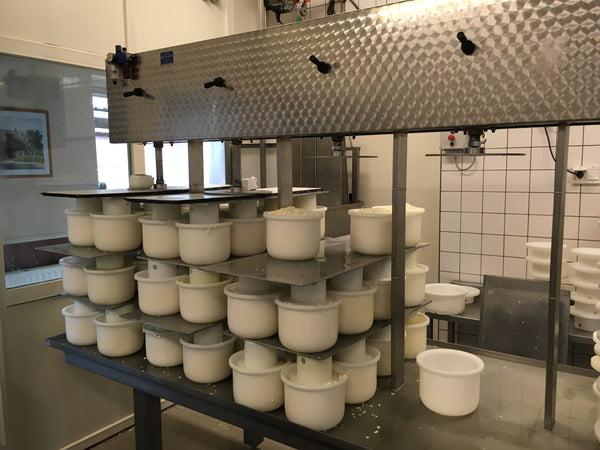
- the cheeses go into a salt bath, where they remain depending on their size, weight, density and seasoning (plain or, for example, with herbs etc.). This salt bath and the bacteria contained in the cheese, which only begin to take effect after a while, are responsible for the originally tasteless curd eventually tasting wonderfully savory, aromatic, buttery … like cheese. By the way, this salt bath is never changed, as the water is so completely saturated with salt that it cannot absorb any more. This also makes it sterile. Nothing unwanted can develop in it, and the bacteria contained in the cheese cannot harm it either. The brine is therefore also one of the reasons why cheese from different farms has a special, characteristic flavor of its own, even though they are all made from “just milk.”

- the cheeses are placed on wooden boards and brushed with liquid plastic. This plastic has replaced the wax that was used in the past, which is initially surprising, but there are compelling reasons for it: the plastic still allows the cheese to breathe, as it lets both moisture and air through, while wax hermetically seals the cheese. Another lesson learned.
- Now begins the maturation in the cheese cellar, which can last for various lengths of time.


I was allowed to try my hand at shaping the cheese and must admit that it is quite an exhausting task. Above all, it is not so easy to judge the correct density and weight. The standard weight is 10 kilos, but the De Jongs also produce 60-kilo wheels, as well as smaller wheels weighing 1, 2 and 5 kilos.
By the way, the curd tastes surprisingly: like nothing. I would have expected it to taste at least milky, but there is really no trace of it. I had to taste it several times, so confused I was at first. You really think your brain is playing tricks on you. All the more so because the curd looks like plain scrambled eggs and has a funny, rubbery-soft consistency.
After being allowed to observe the production, I visited Mrs. De Jong in the adjacent farm boutique, whose doorbell hardly stopped ringing during our visit. The De Jongs' cheese is therefore obviously very popular!

The customers' favorite is the two-year-old medium-aged Gouda, just behind the very young cheeses seasoned with herbs: Gouda with caraway, with alfalfa, or with paprika, basil and garlic. Less popular, but all the more refined, are the 5-year-old wheels that mature under the roof in a large cellar.
I brought back a piece of the 2-year-old and a piece of the 5-year-old Gouda to taste at home in Berlin with our team.
On Mrs. De Jong's recommendation, we tasted the very aged Gouda with Port wine and then also with our fine Madeira. Our verdict: the 2-year-old Gouda tasted truly wonderful – savory, aromatic and full of character. No comparison with sad supermarket Gouda, especially not with the boring young version. The 5-year-old Gouda, on the other hand, tasted very special: almost alcoholic and really very, very savory. Nothing for beginners! Broken into small pieces (it is so hard that it crumbles like Parmesan when cut), it pairs exceptionally well with Port wine.

It tasted best to all of us with the delicious Tawny Port wine by Rita Marques Ferreira (Conceito Vinhos). A combination for connoisseurs who fancy an extraordinary umami experience.
For anyone who fancies a matured Gouda that has nothing to do with plastic-like supermarket cheese, we currently have a 30-month-aged raw-milk Gouda from Holland on offer.
It is made from cow's raw milk and in a traditional way, just like the cheese from Jongenhoeve.
- - -
Epilogue:
About a month after the visit to Jongenhoeve, we went to Sachsenmilch near Dresden to see how industrial Gouda is made. The actual production steps are basically the same here in the largest dairy in Europe (!), but everything is standardized and highly technological, and you can see neither the milk nor the actual cheese-making process for want of all the machines. With a throughput of between 4.8 and 5.2 million liters of raw milk per day, that is hardly surprising. The milk is delivered by a fleet of 190 trucks from various farms in Germany and the Netherlands and is centrifuged and pasteurized for further processing. Around 350 employees work in cheese production and produce 50,000 tons of cheese a year!
I probably do not need to emphasize that this was a completely different experience. It was still exciting every time.
Here are a few more impressions:


- - -
You can find the entire Abenteuer Leben show online in the Kabel Eins media library.

